In Delray Beach, fitness is more than a trend — it’s a lifestyle. From early-morning jogs on the beach to reformer studios tucked inside boutique gyms, locals love a workout that delivers results. But there’s one question that keeps coming up in every conversation:
“What’s the difference between Pilates and Lagree?”
At first glance, it’s easy to see why people are unsure. Both workouts use reformer-style machines. Both emphasize controlled movement, balance, and core strength. And both are considered low-impact workouts that protect the joints while improving overall stability and endurance.
Yet beyond those surface similarities lies a fundamental difference — one that completely changes how your body builds strength, stamina, and tone.
At The Burn Society in Delray Beach, we specialize in Lagree Fitness, a high-intensity, low-impact exercise program that combines body weight resistance with slow, precise movements to challenge your major muscle groups in every session. While Pilates focuses on alignment, breathing, and improved flexibility, Lagree is designed to develop total-body strength and muscular endurance — all while keeping pressure off your joints.
If you’ve never tried Lagree before, join one of our drop-in classes and experience the difference firsthand.
It’s often described as “Pilates on steroids,” but that’s not because you’re lifting heavy weights or moving faster. Instead, Lagree emphasizes time under tension — the art of keeping muscles engaged through every second of movement. By controlling each motion and minimizing rest, your body remains in a constant state of challenge, helping you build lean muscle, improve balance, and increase range of motion.
For many newcomers in Delray Beach, traditional Pilates is the first step toward building a stronger core and learning proper body control. It’s a fantastic foundation for balance, posture, and coordination. But Lagree takes that foundation further. It’s not just about movement — it’s about transformation.
Think of Pilates as learning the fundamentals of movement… and Lagree as applying those fundamentals to a new level of strength and performance.
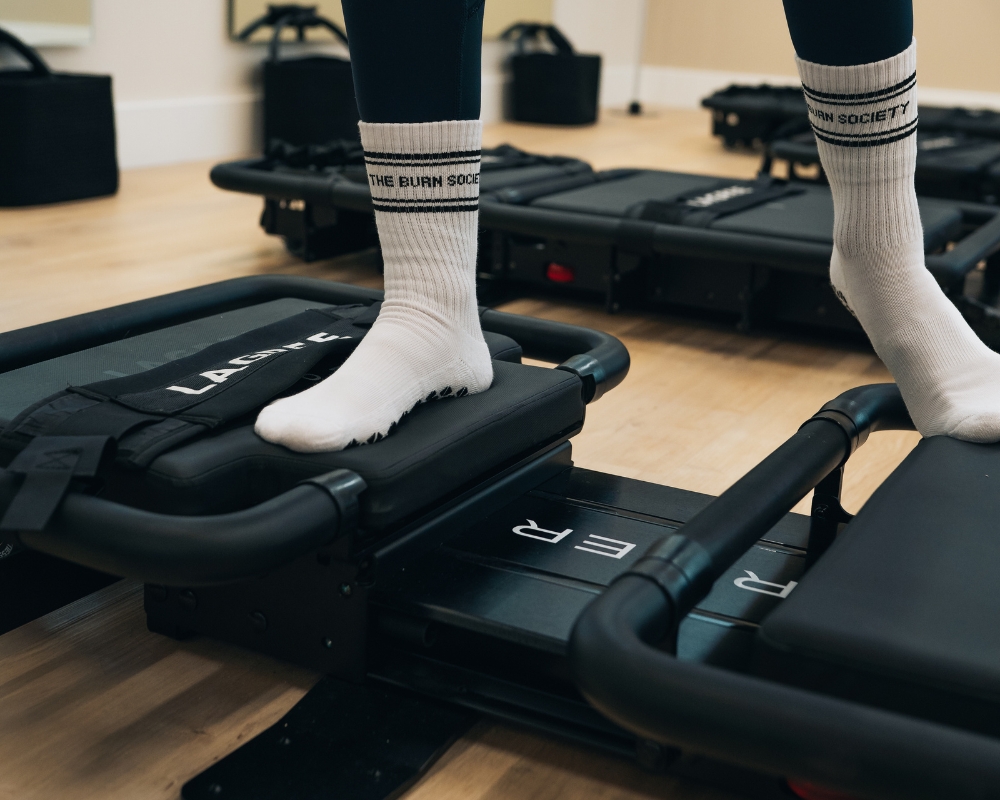
The overlap starts with the machines. Pilates uses the reformer, while Lagree uses the Megaformer — a redesigned version built for intensity, multi-muscle engagement, and fluid transitions. The Megaformer’s adjustable resistance allows you to train multiple major muscle groups simultaneously, building core strength while improving endurance and stability.
Traditional Pilates reformers, by contrast, are designed for slower, restorative movement that emphasizes alignment, flexibility, and precise control over each range of motion. Both methods build strength — but one (Lagree) pushes your limits, while the other (Pilates) refines them.
The confusion also comes from branding. Many studios advertise “Pilates-inspired” or “hybrid” classes, but the experience varies dramatically. At The Burn Society, we make it simple: we’re a Lagree studio — not Pilates-inspired, not fusion, but the real Lagree Method.
Our instructors are trained to help clients move safely and effectively through every high-tension sequence, focusing on muscular endurance and controlled strength rather than quick reps or heavy resistance.
For anyone searching “Pilates Delray Beach”, “Lagree near me”, or “core workouts in South Florida,” knowing the difference can change your entire fitness path. Pilates is excellent for posture correction, injury recovery, and improved flexibility. Lagree, however, delivers faster physical change by combining strength training, body weight resistance, and endurance challenges in one efficient workout.
Where Pilates strengthens — Lagree sculpts.
Where Pilates restores — Lagree transforms.
Where Pilates focuses on form, Lagree amplifies results.
That’s why The Burn Society attracts everyone from high-performing athletes to busy professionals who want maximum results in minimal time. Lagree is efficient, challenging, and incredibly rewarding.
If you’ve ever wondered “Is Lagree Harder Than Pilates?” or “What Makes Lagree Pilates Different?”, you’re not alone. These are the exact questions we hear when clients first step into our Delray Beach studio.
This guide will answer those questions — and more — helping you find the workout that best supports your core strength, flexibility, and long-term fitness goals.
To truly understand the difference between Pilates and Lagree, it helps to start with where each method came from — and what they were designed to achieve. Both share a foundation in control, alignment, and strength training through body weight resistance, but their evolution reflects two very different fitness goals.
Pilates was developed by Joseph Pilates in the early 1900s as a rehabilitation system to improve posture, flexibility, and overall core strength. It was born out of necessity — Pilates wanted to help injured soldiers and dancers restore mobility and range of motion through mindful, controlled movement.
At its core, Pilates is about balance — not just physical, but mental. Every motion is intentional, designed to strengthen the body from the inside out. Breathing, focus, and muscle control are synchronized so that no energy is wasted.
Over the years, Pilates evolved from its original mat-based exercises into a dynamic exercise program that uses reformer machines with springs, straps, and pulleys. These tools add gentle resistance, helping participants lengthen muscles rather than bulk them up. The result is a lean, toned physique with better posture, improved flexibility, and stronger stabilizing muscles.
Pilates is especially effective for activating the deep core muscles — the abdominals, obliques, back, and hips — which support proper alignment and reduce risk of injury. By strengthening these major muscle groups, Pilates helps people move more efficiently in daily life, sports, and other workouts.
It’s a method that promotes longevity, body awareness, and balance. But for some, especially those seeking faster or more visible strength results, the slow, restorative nature of Pilates can feel too gentle. That’s where Lagree enters the picture.
The Lagree Method was created by Sebastien Lagree in the early 2000s. Drawing inspiration from Pilates’ focus on control and alignment, Lagree saw an opportunity to make the method more dynamic, results-driven, and intense — without sacrificing its joint-friendly approach.
His innovation was the Megaformer, a machine that looks like a Pilates reformer but functions on an entirely different level. The Megaformer allows for compound movements that engage multiple major muscle groups simultaneously — creating a full-body challenge that builds muscular endurance, core strength, and balance all at once.
Unlike traditional resistance training, which isolates one muscle group at a time, Lagree prioritizes total-body integration. Each move requires stability, coordination, and continuous tension, forcing your core muscles to remain active from start to finish.
Instead of quick reps, Lagree emphasizes slow, controlled, and constant movement — a principle known as time under tension. This approach keeps your muscles firing the entire workout, improving strength, stamina, and range of motion while torching calories.
It’s a workout that redefines intensity.
Lagree’s combination of high-intensity, low-impact resistance means you’ll experience the deep muscle shake of an advanced body weight exercise program, but without the strain of heavy weights or repetitive stress.
At The Burn Society in Delray Beach, every class follows these principles: slow transitions, constant engagement, and full-body coordination. Clients often describe it as “45 minutes of focus” — challenging every muscle, including stabilizers most workouts overlook. Over time, this builds muscular endurance, sculpts lean muscle, and enhances flexibility through better control and strength.
Both Pilates and Lagree prioritize form, precision, and control, making them two of the safest and most effective low-impact training systems in the world. But while Pilates builds the foundation, Lagree builds upon it — adding intensity, endurance, and progressive overload that create visible changes faster.
Here’s a simple way to think about it:
Pilates improves coordination and range of motion — Lagree amplifies muscular endurance and overall strength.
Pilates focuses on balance and rehabilitation — Lagree focuses on transformation and performance.
For example, a traditional Pilates move like the “hundred” emphasizes controlled breathing and core engagement, while the Lagree version of that same principle would hold a plank position on the Megaformer — adding instability, resistance, and isometric holds to maximize core strength.
The two methods share a philosophy, but their outcomes differ dramatically. Pilates builds awareness and recovery; Lagree builds endurance, tone, and measurable power.
Understanding where each method comes from helps you choose what your body needs most. If your goal is improved flexibility, posture, or gentle recovery, Pilates is the ideal start. But if you’re looking for an exercise program that increases muscular endurance, tones your major muscle groups, and challenges your entire body in just 45 minutes, Lagree is the next step.
At The Burn Society, we often see clients begin with Pilates elsewhere and transition to Lagree once they want a workout that pushes their limits while maintaining the same joint-friendly, mindful approach. It’s not about replacing one with the other — it’s about evolving your fitness journey.
To learn more about how Lagree builds visible tone and lasting strength, explore our next guide:
👉 Can You Get Toned From Lagree?
Most people in Delray Beach walk into their first class expecting Pilates and Lagree to feel similar. After all, both involve reformer-style equipment and controlled movement. But within minutes on the Megaformer, they realize something completely different is happening.
The difference isn’t just in intensity — it’s in the way your muscles are challenged.
A Pilates session is rhythmic, restorative, and deliberate. Movements are performed slowly and precisely, often using body weight or light spring resistance. The goal is to improve core strength, alignment, and range of motion through smooth, controlled transitions.
In a typical Pilates class, you might spend time perfecting foundational movements such as leg circles, bridges, or roll-ups. Every motion is connected to breath, allowing the mind and body to sync. You’ll engage smaller stabilizing muscles that improve balance, posture, and improved flexibility.
For many people, Pilates feels almost meditative — each movement flows into the next, creating a calm yet focused experience. It’s excellent for developing awareness of your major muscle groups and for retraining your body to move efficiently and gracefully.
After a consistent Pilates practice, you’ll notice better posture, looser hips and hamstrings, and increased joint mobility. It’s ideal for those looking for a mindful exercise program that enhances flexibility, strength, and long-term joint health.
Now, step onto the Megaformer at The Burn Society, and the energy changes instantly.
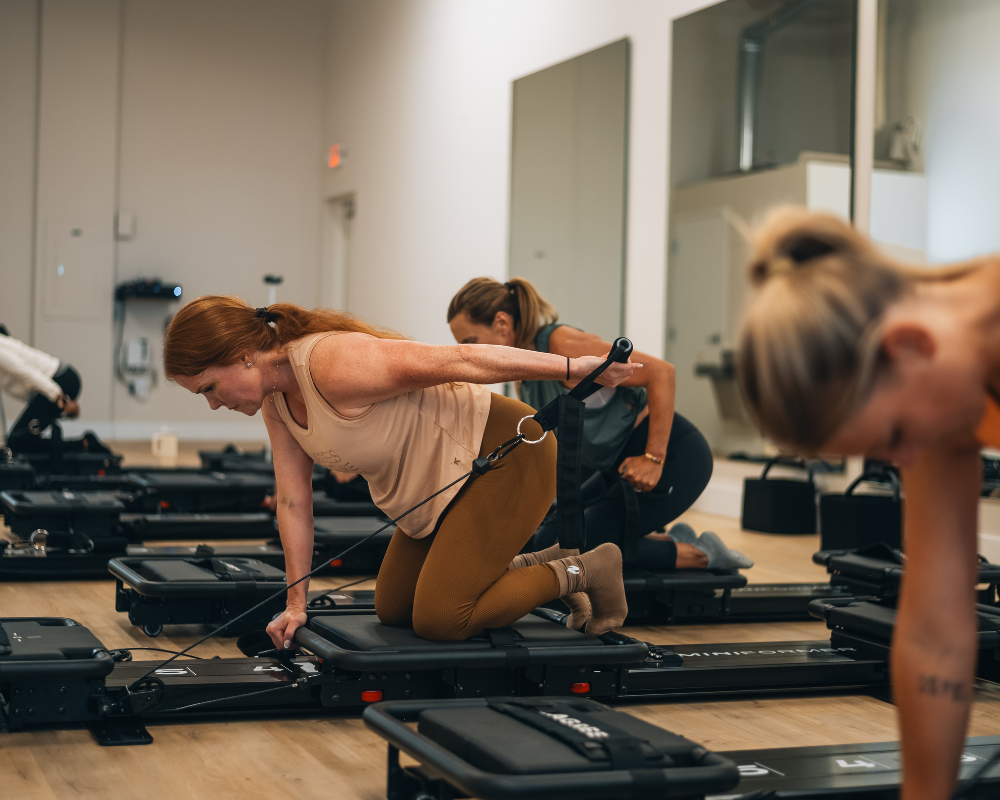
The Megaformer looks familiar but moves differently — its sliding carriage, adjustable springs, and stationary platforms create continuous resistance. Every exercise targets multiple major muscle groups simultaneously.
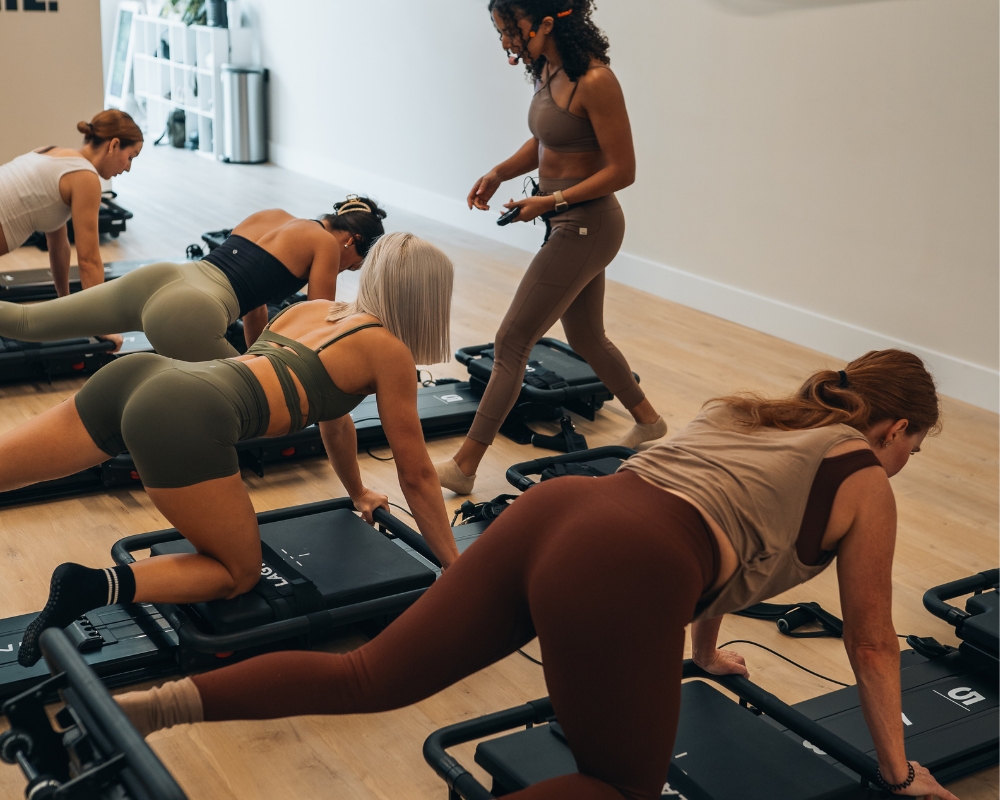
In a Lagree class, you’ll hold slow, controlled movements for extended periods — sometimes up to 60 seconds per exercise — to maximize time under tension. Your core muscles never get a break. Whether you’re performing lunges, planks, or oblique crunches, your stabilizers, glutes, hamstrings, and abs remain engaged from start to finish.
Instead of simply stretching or aligning, Lagree workouts challenge muscular endurance by keeping the muscles firing through constant resistance. You’ll feel your body shaking — a sign that your muscles are reaching full activation and strength adaptation is occurring.
It’s not about speed; it’s about control under pressure.
Lagree’s signature benefit is efficiency. In just 45 minutes, you’ll target your core strength, improve total-body coordination, and train your stabilizers and movers simultaneously. The slow tempo amplifies the intensity — forcing you to recruit your body weight and control every inch of your range of motion.
Many clients describe the experience as “intense but empowering.” The shake that happens during a Lagree class is your muscles learning to handle resistance more effectively. And over time, that translates into visible tone, improved posture, and higher energy levels throughout the day.
Both Pilates and Lagree emphasize form and alignment, but Lagree takes those same principles and turns them into a progressive resistance challenge.
The addition of compound, multi-joint movements on the Megaformer means your major muscle groups — core, glutes, hamstrings, chest, shoulders, and back — are constantly engaged together. The controlled instability of the Megaformer forces your body to adapt, stabilizing with the core muscles during every motion.
This synergy builds not just strength, but functional strength — the kind that improves your performance in other workouts, daily activities, and even posture at your desk. Over time, you develop the ability to move with more control and endurance, reducing the risk of injury while maximizing your strength potential. The best way to understand the difference is to experience it
At The Burn Society in Delray Beach, every Lagree class is designed to deliver measurable results for both beginners and advanced athletes.
We focus on muscular endurance, improved flexibility, and functional movement, blending precision and performance in every routine. Our instructors are trained to cue form, breathing, and tension so that each client maintains perfect alignment throughout the workout — even when muscles start to shake.
We see clients from all fitness backgrounds — Pilates enthusiasts, runners, weightlifters, and yogis — discover that Lagree challenges them in completely new ways. It’s the workout you didn’t know your body needed until you feel that first deep burn.
Our sessions are structured around:
The result? A lean, sculpted body built on stability, endurance, and resilience.
If your goal is gentle recovery, posture improvement, and range of motion, Pilates is an excellent foundation. But if you’re ready to amplify your core strength, build lean muscle, and challenge your major muscle groups with a low-impact but high-intensity exercise program, Lagree is the next level.
At The Burn Society, our Lagree classes aren’t about competing with Pilates — they’re about complementing it. The two methods share DNA, but their outcomes differ. Pilates helps you build balance. Lagree helps you redefine strength.
Curious how the Lagree method delivers such visible tone and endurance?
👉 Read next: Can You Get Toned From Lagree?
Ready to attend a class? Schedule your class with our first-time special today.